Beyond Deep Breathing: Ways to Calm Your Nervous System When Anxiety Isn’t Letting Up
Why traditional anxiety coping skills don’t work for everyone and what to try instead.
I’m a therapist in Nashville, Tennessee and I know my way around anxiety. I see it, I feel it, and I work with it every day. And I’ve seen how frustrating it can be when the usual tools don’t seem to help.
So let’s be real:
If deep breathing worked, you probably wouldn’t be here. You’ve tried the grounding exercises. The “five senses”. The calming apps.
And maybe they help a little - but your body still feels on edge. Or frozen. Or buzzing with something you can’t quite name.
At some point you might even start wondering, “Why isn’t this working for me?”
The shorter answer: Nothing is wrong with you.
The longer answer is that not all anxiety is the same and not all nervous systems respond to the same tools.
Sometimes what’s activated isn’t your mind. It’s your body.
And bodies tend to be a little less interested in logic.
Many of the people I work with here in Nashville tell me some version of the same thing:
"I know I’m safe… but my body still feels like something’s wrong."
If that sounds familiar, you're not alone.
Your nervous system is doing exactly what it learned to do (and got really good at).
It might just need different kinds of support to switch things up.
What Anxiety Can Feel Like in Your Body and Mind
Anxiety doesn’t always look like panic attacks and spiraling thoughts. Sometimes it does. But for many people, anxiety shows up in less obvious ways.
Anxiety can show up in ways like:
overthinking every decision
feeling responsible for everything
staying busy all the time
struggling to actually relax
lying in bed with a brain that suddenly wants to review your entire life (Why does the brain do this at 11:37pm specifically? No one knows.)
It can also show up physically: tight chest, racing heart, restlessness, difficulty sitting still, or trouble turning your mind off. For some people anxiety is loud, while for others it’s more like a steady hum in the background - always running, even when things are technically “fine”.

Why Anxiety Lives in the Body (Not Just Your Thoughts)
When your brain senses threat (real or perceived) your nervous system shifts into survival mode.
These survival modes can show up as:
Fight — irritation, tension, snapping at people
Flight — restlessness, racing thoughts, urgency
Freeze — shutting down, zoning out, feeling stuck
Fawn - over-accommodating, people-pleasing, trying to keep the peace
None of these responses mean something is wrong with you.
They mean your nervous system is doing its job.
In many ways, anxiety is protection.
Your system is scanning for possible problems and trying to keep you safe - sometimes by staying hyper-alert, sometimes by pushing you to solve everything immediately, and sometimes by trying to control uncertainty.
Helpful in actual danger.
Slightly exhausting when applied to everyday life.
And here’s the tricky part:
Once your nervous system shifts into survival mode, the thinking part of your brain becomes… less persuasive. Which means logic doesn’t always calm the body down.
You can know everything is fine and still feel anxious.
And this is why traditional advice like “just take a deep breath” doesn’t always work.
(If breathing exercises worked for everyone, anxiety would be a much simpler problem to solve.)

Ways to Calm Anxiety Beyond Deep Breathing
The tricky part about anxiety is that what works for one person doesn’t always work for another.
So instead of looking for the perfect tool, it can be more helpful to figure out what your body actually responds to.
Think of these less like something you need to get right and more like options you get to play around with.
Some will land. Some won’t. That’s part of the process.
Here are a few ways to calm anxiety:
01 - Let Your Body Move (to Release Anxiety)
Anxiety often builds up as energy in the body. When that happens, sitting still and trying to breathe slowly can actually make the feeling louder. Intentional, gentle movement can help release some of that built-up activation.
Gentle movement can help release anxiety, such as:
walking
yoga or gentle stretching
dancing (yes, really)
swaying or rocking
shaking out your arms or legs
The goal isn’t intense exercise.
When the system is already anxious, high-intensity movement can sometimes make things feel more amped up.
Slower, rhythmic movement tends to help the body settle more easily.
Think: calming, not sweating.

02 - Give Your Senses Something New
Your body constantly responds to sensory information:
Temperature. Touch. Sound. Smell. Taste.
Switching up what your senses are taking in can help interrupt the anxiety cycle and shift how your body responds.
Some simple sensory shifts that can help calm anxiety:
splashing cold water on your face
holding something cold (hands, face, or even your chest)
wrapping up in a weighted blanket
touching something textured
smelling a calm or grounding scent
chewing gum or sour candy
listening to calming or familiar music
taking a warm shower or holding something warm
stepping outside for fresh air
taking a sip of something you enjoy (tea, coffee, something refreshing)
You don’t have to overthink this - just pick one and see how your body responds to it.
Sensory tools work because they give your body something immediate and physical to respond to.
Sometimes the body just needs a different sensory experience to interrupt the loop - and give it a chance to slow down.

03 - Help Your Brain Notice You’re Safe
Your brain is constantly scanning for danger - even without you realizing it.
It’s very good at this job.
Sometimes a little too good.
When anxiety ramps up, the brain can get stuck in threat-detection mode.
One way to interrupt this is through orienting - gently helping your brain notice that the environment around you is safe.
Safety cues for an anxious brain can look like:
slowly looking around the room
noticing colors or shapes
naming objects you see
visually tracking something moving
looking for three things that feel comforting
describing something you see
focusing on natural elements (trees, sky, light)
You’re basically reminding your brain:
“Hey…we’re okay here.”
(and it will probably need that reminder more than once)
These small attention shifts help the brain register safety which in turn helps your anxiety begin to settle.
04 - Give Your Mind Something Else to Do
Sometimes anxiety isn’t just physical - it’s mental looping. Your brain keeps replaying the same thought. Or problem. Or conversation from three days ago. Trying to force the thoughts to stop rarely works. But giving your brain something actionable or structured to focus on often helps.
It can also help to choose something simple and within your control - giving your brain a sense of direction instead of spinning.
Here are a few ways to redirect your focus when anxiety is looping:
a puzzle
reading something engaging
listening to an audiobook
organizing a small task
writing your thoughts down and stepping away
This isn’t about ignoring anxiety. It’s about giving your brain somewhere else to go so it doesn’t stay stuck in the same loop. The thoughts may still be there. They just don’t have to be the loudest thing in the room.
And don’t forget: mental loops often calm more easily when the body is also regulating, which is why pairing these with movement or sensory tools can help even more.
05 - Use Rhythm to Regulate with Sound for Your Anxiety
Rhythm is incredibly regulating because it creates predictability - and predictable patterns signal safety to the brain.
When something feels steady and repetitive, your body has something to “lock into,” which can help shift out of urgency and into a more grounded state.
Rhythm-based tools that can help regulate anxiety include:
walking at a steady pace
rocking
tapping your hands or feet
gently tapping your shoulders or arms
bouncing a ball or lightly drumming your fingers
humming or singing
listening to bilateral music (alternating sound between ears)
Rhythm signals safety to the brain in a way words often can’t and sometimes that’s all it needs to take the edge off.
06 - Borrow Someone Else’s Calm
Humans regulate through connection - especially safe connection.
(and yes - your body knows the difference)
This is why anxiety often feels easier to manage around the right people and harder when you’re alone or around people who feel tense, unpredictable, or just a little off.
Sometimes the fastest way to calm your body is simply being around someone who feels grounded or easy to be with.
Ways to support anxiety through connection might include:
talking with a trusted friend
sitting quietly next to someone
making eye contact
sharing a laugh
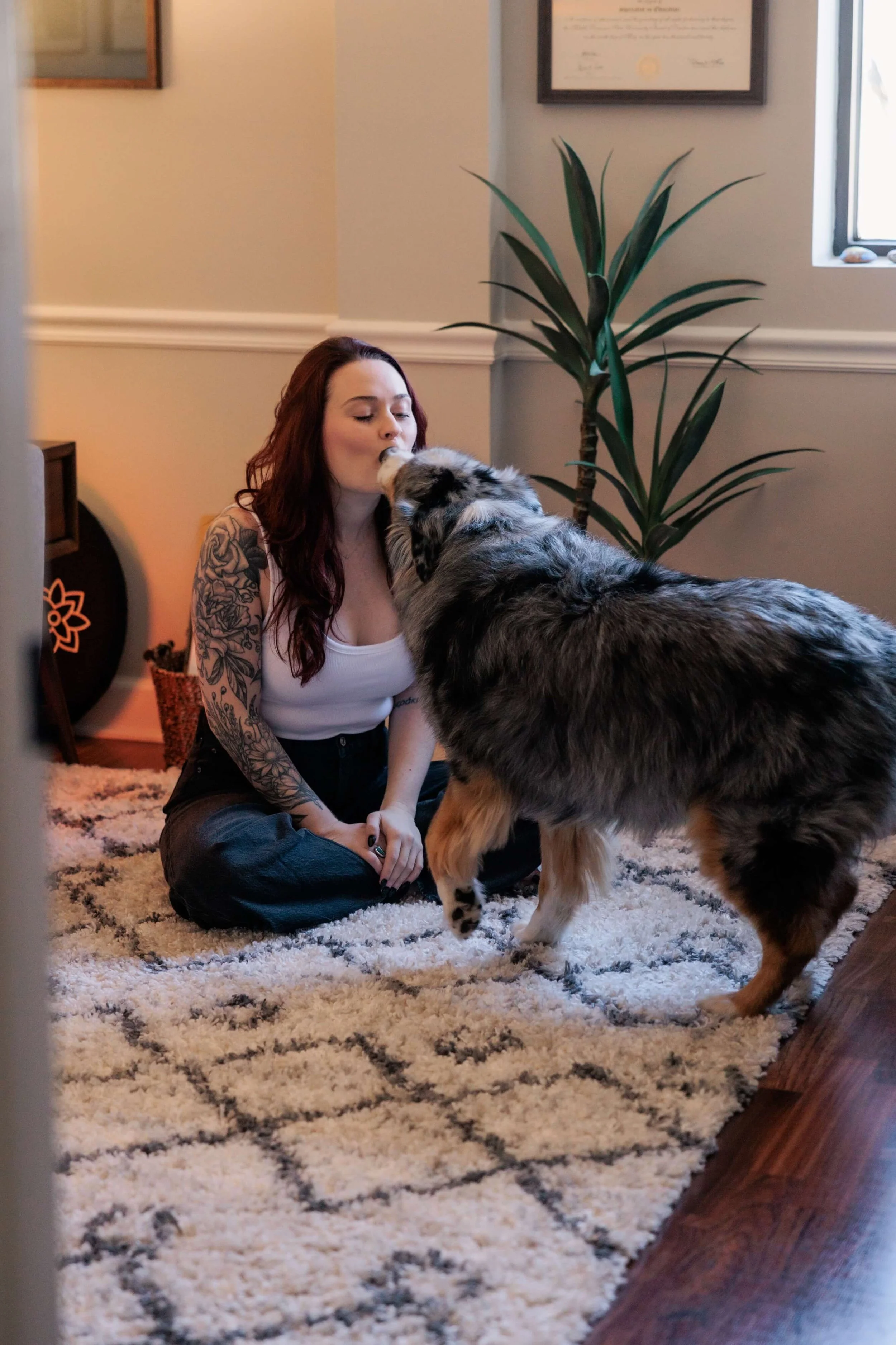
petting an animal (one of my personal faves)
hugging someone safe
You don’t necessarily need advice or solutions - just proximity to someone who feels steady enough.
We are wired for connection.
And calm can be contagious in the best way.
07 - Let Your Eyes Rest
Where and how you use your eyes can influence how your brain processes experiences. Letting your gaze rest (or soften) can help your body begin to slow down.
Visual grounding techniques that can help your nervous system settle:
resting your gaze on one steady point in the room
following something slowly moving with your eyes
focusing on something visually calming (like nature, light, or a plant)
softening your focus instead of scanning the room
These gentle visual shifts can help your brain move out of “scanning for danger” mode and into something more grounded.
(Big wink to Brainspotting - but we’ll save that deep dive for another post).
Why Regulating Your Nervous System Takes Practice (and Might Feel Clumsy at First)
One of the biggest myths about coping tools is that they should work immediately.
In reality, regulation is a skill - and like most skills, it takes practice.
Think of it like building a new muscle - the more you practice, the stronger your system gets, and the easier it becomes to shift out of anxiety.
At first, it can feel awkward, uncomfortable, or even ineffective. That’s normal. Over time, it starts to feel more natural.
Repetition matters more than perfection here.
If anxiety feels like an 8 out of 10, the goal usually isn’t to reach zero. A more realistic shift might be moving from an 8 to a 5 or 6.
And that’s not small - that’s your system starting to learn something new.
Small shifts, repeated over time, are what actually create change.
Why Anxiety Keeps Coming Back (Even When You’re Doing Everything Right)
For some people, these tools are enough to help anxiety ease.
Other times, anxiety keeps returning - not because you’re doing anything wrong, but because your body learned how to operate this way for a reason.
Chronic stress, burnout, relational wounds, or environments where you had to stay on edge or didn’t feel safe can shape how your body responds now.
In those cases, the goal isn’t just managing anxiety in the moment - it’s helping your system learn that it doesn’t have to stay on high alert all the time.
Signs your anxiety may be connected to deeper nervous system patterns include:
your body reacting quickly even when your mind feels calm
feeling on edge without a clear reason
struggling to fully relax, even in safe environments
looping through the same patterns no matter how many tools you try
When anxiety shows up in these ways, it’s often a sign that your system may need a different kind of support - not just more tools.
When to Find Support or Resources for Anxiety That Won’t Go Away
When anxiety keeps coming back in this way, it can feel frustrating - especially when you’re already doing “all the right things.”
If anxiety feels like it’s constantly taking over…
or like you’re always managing it rather than actually feeling relief…
or like it’s starting to hold you back from living the life you want…
it might be a good time to explore deeper support - the kind that helps you understand and shift what’s driving the anxiety, not just manage the symptoms.
This might look like working with a therapist, finding resources that resonate with you, or exploring approaches that focus on both your thoughts and your body - not just one or the other.
The goal isn’t just to cope with anxiety, but to understand it and begin shifting what’s underneath it.
If you're in Nashville (or TN) and wondering whether working together might be a good fit, you're welcome to reach out to learn more about how I approach this work and how I might support you.
The Takeaway (From a Therapist Who Gets Anxiety)
Your system is responding the way it learned to protect you.
And just like it learned those patterns, it can learn new ones - not perfectly or all at once, but through small experiments, support, and a willingness to try something different.
Change is absolutely possible. And your system might be more capable of it than you think.
So take a few of these tools, get a little clumsy with them, and see what your system responds to. You might be surprised what starts to shift.
Reach out today if you’re ready to start tackling anxiety together.