Therapy in Tennessee




Trauma Therapy for Relational Trauma, Family System Wounds, and Survival Patterns.
Helping you move beyond survival and reconnect with a life that feels more present, meaningful, and your own.
Trauma is not defined by how dramatic something looked from the outside. It’s defined by how unsafe it felt on the inside.
For some, trauma is tied to a single overwhelming event (often described as PTSD).
Complex trauma usually is not one single event. It develops over time in relationships or environments where you had to adapt in order to cope, stay connected, or survive. It’s less about what happened and more about how your nervous system and sense of self were shaped by it.




Trauma Therapy is for Everyone.
Therapy for the people who grew up adapting - often within family dynamics, emotional neglect, high-control environments, religious harm, or relational wounds that were hard to name but deeply shaping.


Some people arrive here after experiences that felt overwhelming or unsafe, while others recognize patterns that formed slowly over time in environments where their needs were not consistently supported.
Complex trauma often develops in environments where emotional safety, attunement, autonomy, or consistency were missing, even if no single moment felt “traumatic” at the time.
You may seek therapy because you recognize yourself in things like:
staying hyperaware, responsible, or “on alert” (hypervigilance)
being accommodating or “easy” to avoid conflict
feeling numb, detached, or not fully present (dissociation)
struggling to trust your intuition, questioning your thoughts
feeling disconnected from joy, meaning, or a clear sense of self
feeling like you are either “too much” or “not enough”


Even if nothing looked obviously bad from the outside, the impact may still be real.
Sexual trauma, spiritual or religious harm, high control relationships, or oppressive systems can layer onto these experiences and reinforce patterns that were already in place.
If you see yourself here, it does not mean you are broken.


A Stable Way of Doing Therapy
Trauma work deserves care. I will not push you to go faster than your system can handle.
We build stability before depth. Safety before intensity. You are never pressured to tell your story before your body feels ready.
I am paying attention not just to what you say, but how it lands in your nervous system. We slow things down when needed and build emotional bandwidth gradually. This isn’t about ripping the lid off everything at once, but moving at a pace where your body doesn’t feel ambushed by your own story.


Over time, clients often feel more steady and less confused about their patterns.
They begin recognizing when survival mode is running the show and responding with choice instead of reflex. There is more self-trust. More clarity. Confidence rooted in understanding rather than self-criticism.
Clients often describe feeling less hijacked by old reactions and more able to pause, choose, and respond from who they are now.
The goal is not to erase your past.

My approach to trauma work is gentle, relational, and guided by your pace rather than a timeline.
We create enough safety to slow down and understand the patterns that formed, without rushing to fix or explain them. This work isn’t about forcing change or rushing insight. It’s about understanding, rebuilding self-trust, and developing a steadier relationship with yourself over time.
And if your system learned these patterns, it can also learn something new.
In trauma therapy, we gently explore:
-
![Black plant icon.]()
how your early experiences shaped your sense of safety and self-worth
-
![Black plant icon.]()
patterns that once protected you, even if they are not helping now
-
![Black moon icon.]()
staying connected to yourself instead of shutting down or self-abandoning
-
![Black heart icon.]()
slowing down and listening to your body when emotions feel big
-
![Black flower icon.]()
beliefs about yourself that formed in environments where your needs were not fully met
-
![Black asterisk icon.]()
rebuilding self-trust, steadiness, and a clearer sense of who you are







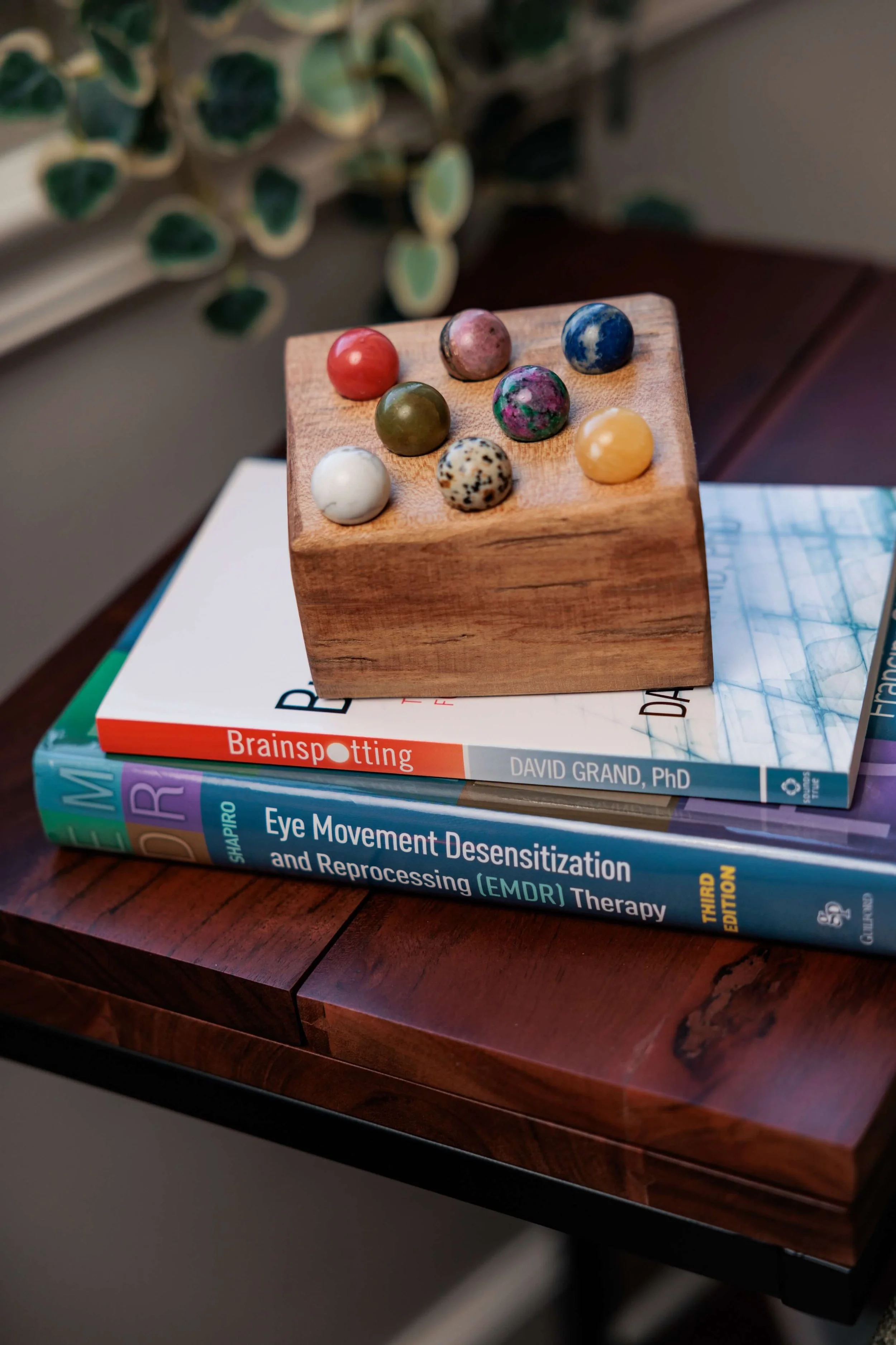
I integrate approaches such as somatic therapy, Brainspotting, EMDR, attachment-focused work, mindfulness practices, and gentle parts-work exploration that helps us understand the protective and vulnerable pieces of you that developed along the way.
There is no checklist here. No pressure to do it perfectly. Nothing gets rushed before you are ready.
This work unfolds with care, choice, and respect for your pace.



Start your therapy journey
Kaylie offers therapy in-person near Nashville, Tennessee. She offers therapy for complex trauma, anxiety, relationship patterns, and grief and loss.
Her holistic therapy approach is where insight meets nervous system healing.
This is a space where your patterns make sense, your nervous system can exhale, and you don’t have to perform to belong.